
My new photography store (powered by Amazon.com) is at my Web site here, and as a stand alone site here. It has some of my favorite photography books and photo equipment. Ordering, payment, and shipping are all taken care of by Amazon’s safe and efficient system. If the feed from Amazon to my photography store doesn’t show up right away, just refresh the page.
Category Archives: Photo Gear
Turn Your Camera Into An Incident Light Meter
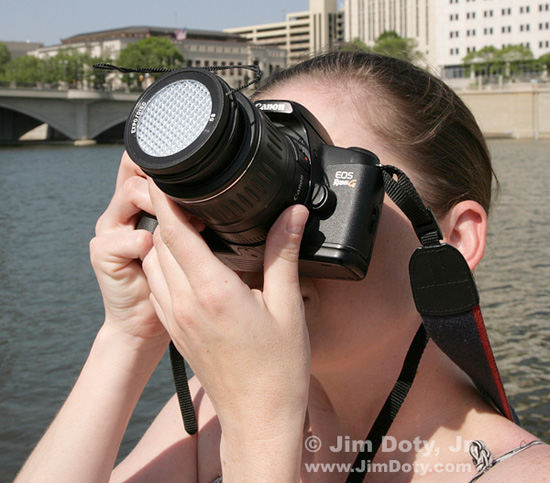
Photographer Using an ExpoDisc
There are a lot of advantages to using an incident light meter, and you can read about them here. But what if you don’t have an incident light meter? Or you are packing light and don’t want to take your incident light meter with you? There are several less expensive alternatives.
Simplify Your Life with an Incident Light Meter
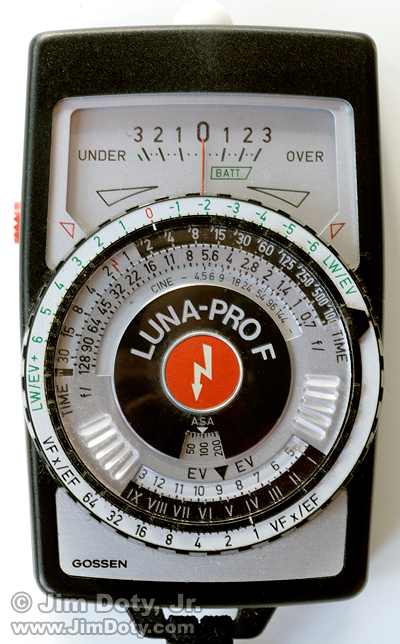
Incident Light Meter. Photo © Jim Doty Jr.
There’s no question that in some complex metering situations, it can be tough to figure out the best exposure with the meter in your camera. An incident light meter can be quicker, faster, simpler, and more accurate in some of those same situations.
BEST DIGITAL CAMERAS – 2010
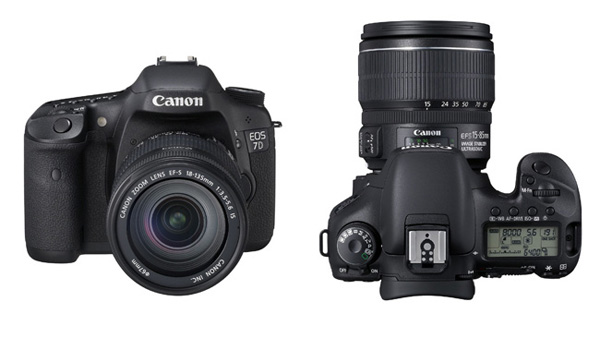
The list that follows has the highest rated SLR, hybrid, and fixed lens cameras for the last 12 months.
Q&A: Canon T2i vs T1i
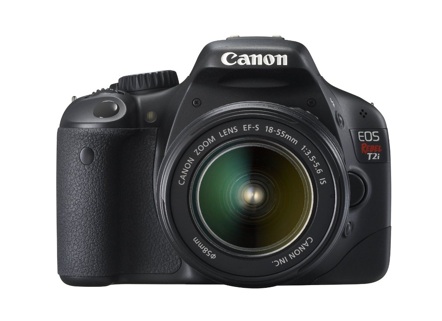
Canon EOS Rebel T2i (550D, Kiss X4)
Every once in a while, I post my answer to a question that I receive by email. This one has to do with choosing between two camera bodies: the Canon T1i and T2i. When I am thinking about buying a camera, the first thing I do is to check out some trusted online sources. These are sites that do this kind of comparative thing all the time. I checked two of my favorite sources before answering the question below. Although the question is about choosing one camera or the other, I also cover the issue of upgrading from the T1i to the T2i.
Best Panorama Gear: Living In Pano Heaven
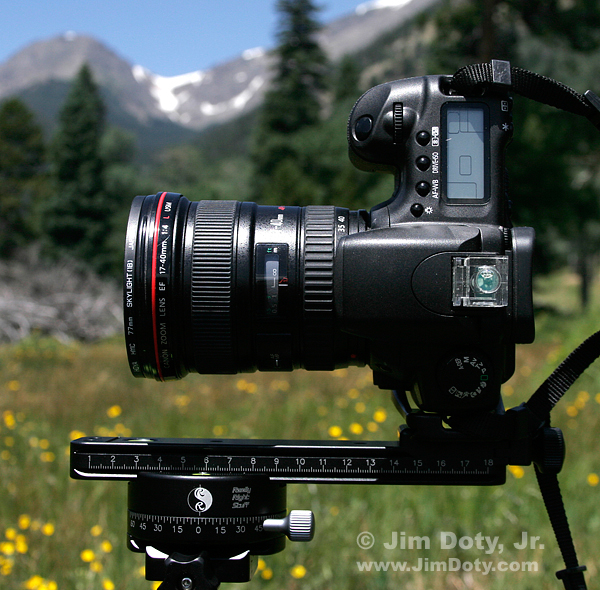
CAmera, nodal slide, and panning clamp
If you are using an Arca-Swiss compatible quick release system, which I highly recommend, two simple pieces of easy-to-carry equipment can put you in panorama heaven. Get the full story here.
The Best Camera Quick Release System
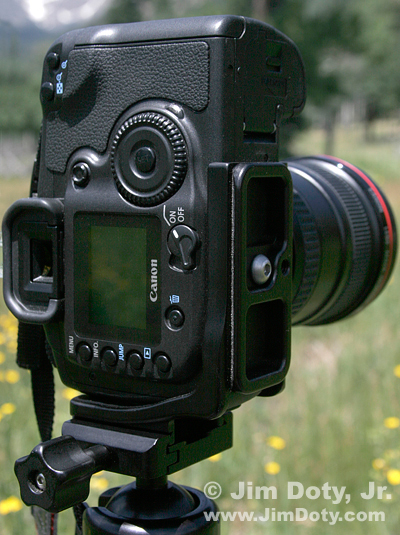
Arca-Swiss compatible "L-bracket" and tripod head
Mounting a camera onto the screw on top of a tripod head is time consuming. Doing it in the dark when your hands are cold is annoying. Once the camera is mounted, if you flop the camera over to the side to take a vertical photo, the camera tries to rotate on the screw. To provide a solution, all kinds of “quick release systems” have been created. Some of them work quite well, some not so well. Most systems have a weakness of one kind or another.
One system has become the defacto standard for serious photographers. It is arguably the best. If you are tired of the nuisance of screwing your camera onto your tripod head, or if you’ve grown weary with the problems created by an inferior quick release system, it is time for a change. Go here.
KEEPING YOUR WORLD STRAIGHT WITH A DOUBLE BUBBLE LEVEL
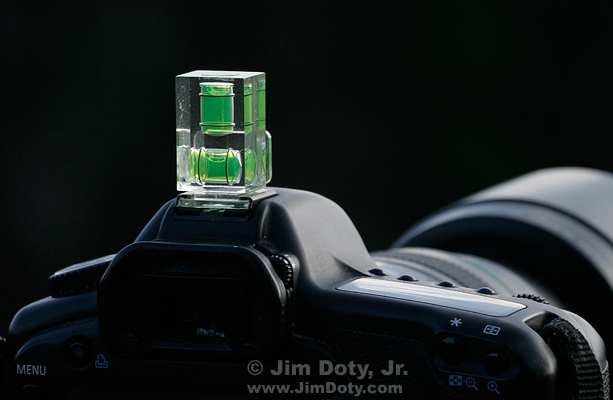
Double Bubble Level
Read the complete information article here.
Save money and buy a Manfrotto Double Bubble Level from Amazon.com (and get free shipping).
TRIPOD RECOMMENDATIONS – SOME OF THE BEST – 2010
Looking for a tripod? This is the place to find information, recommended models, and links to more information.
It is best to buy your tripod legs and tripod head separately. The best brands are interchangeable so you can match the legs you want with the tripod head that you want.
For years I have been recommending Bogen/Manfrotto and Gitzo tripods. . . .
SOME OF THE BEST TRIPOD HEADS – 2010
The short list.
3-Way Tripod heads:
Manfrotto 056 3D Junior Head (replaces 3025)
Manfrotto 3025
Manfrotto 115 3D Super Junior Head (replaces 3028)
Manfrotto 410 Junior Geared Head
Ball Heads:
Slik Pro Ballhead 800
Kirk Enterprises BH-3
Kirk Enterprises BH-1
Really Right Stuff BH-40
Really Right Stuff BH-55
THE BEST TRIPOD HEAD QUICK RELEASE SYSTEM
Short List: Arca-Swiss
The Arca-Swiss quick release system is arguably the best quick release system and certainly the most universal among professional photographers. The system is simple and you can start for less than $80 and use almost any tripod head you now own. . . .
iPHONE 3G PHOTOS

The Mackinac Bridge. Michigan. Photo © Jim Doty Jr.
Can you take nice photos with an iPhone? Yes. Does it have its limits? Of course.
I have been experimenting with the photo capabilities of an iPhone 3G. The files are small, 600×800 pixels, but the image quality can be quite good under certain circumstances. This is a switch for me since I usually take photos with a full frame digital SLR. But I have been having fun with the iPhone and learning what it can and can’t do.
Q&A: FLASH AND GUIDE NUMBERS

Sunlit Portrait with Fill Flash. Photo © Jim Doty Jr.
Today’s question is brought to you by Powdermilk Biscuits.
Wait – wrong show. My apologies to Prairie Home Companion. (The delightful movie was on TV recently.)
Today’s Q&A is for all of you that learned to use Guide Numbers and manual flash exposure. If you are a little rusty in that department, or if you were weaned on TTL flash, you can brush up on how to use the guide number (GN) for your flash to determine a manual flash exposure by reading the Flash Basics article at my photography web site. If you are a little rusty with f-stops and exposure, go here.
Now for the Q&A:
BEST DIGITAL SLRs – 2009
You can’t go far wrong buying a recent model Digital SLR. They are all good cameras and most of them are great cameras.
Over the last twelve months, the following DSLRs received a “Highly Recommended” rating from DP Review, their highest rating (with sensor size in megapixles – mp):
Canon EOS 5D Mark II, 21 mp
Canon EOS 7D, 18 mp
Canon Digital Rebel T1i, 15.1 mp
Nikon D3X, 24.5 mp
Nikon D300S, 12.3 megapixels
Nikon D5000, 12.3 mp
Olympus E-620, 12.3 mp
Olympus E-30, 12.3 mp
Panasonic Lumix DMC-GH1, 12.1 mp
Panasonic Lumix DMC-G1, 12.1 mp
Pentax K-7, 14.6 mp
BEST POINT AND SHOOT DIGITAL CAMERAS – 2009
2009 SHORT LIST (Top rated cameras listed by name, sensor size in megapixels – mp, and the zoom range of the lens):
Best point and shoot “transitional cameras” (point and shoot cameras that take interchangeable lenses):
Olympus Pen E-P1, 12.3 megapixels, interchangeable lenses
Panasonic Lumix DMC-GF1, 12.1 megapixels, interchangeable lenses
Best point and shoot cameras:
Canon PowerShot SD880 IS, 10 mp, 4x zoom
Canon PowerShot SX110 IS, 9 mp, 10x zoom
Canon PowerShot SX10IS, 10 mp, 20x zoom lens
Fujifilm FinePix F100fd, 12 mp, 5x zoom
Fujifilm FinePix F200 EXR, 12 mp, 4.4x zoom
Panasonic Lumix FZ28, 10.1, 18x zoom
Panasonic Lumix LX3, 10.1, 2.5x zoom
Panasonic Lumix TZ5, 9.1 mp, 10x zoom
Panasonic Lumix ZS1, 10.1 mp, 12x zoom
Panasonic Lumix ZS3, 10.1 mp, 12x zoom
Best underwater point and shoot cameras:
Canon Powershot D10, 12.1 mp, 3x zoom lens
Panasonic Lumix DMC-TS1, 12.1 mp, 4.6x zoom
LENS REVIEW: Tokina AT-X PRO SD 12-24mm F4 IF Lens
For some time now, I’ve been recommending this lens to friends looking for a high quality, super wide-angle lens. It’s not quite as wide as the 10mm super wide-angle lenses, but it makes up for it in superior image quality. If I didn’t have a Canon EF-S 10-22mm lens for my digital camera with an APS-C sensor size, I would be using the Tokina 12-24mm lens.
DPReview recently posted an on online review of this lens. The result isn’t surprising:
“The 12-24mm returns extremely good results in our studio tests, with impressive image quality across the range. Perhaps as a result of its more modest wideangle ambitions, it comprehensively outperforms both the Tamron 10-24mm F3.5-4.5 Di-II and the Sigma 10-20mm F4-5.6 EX DC HSM. Indeed overall it’s arguably a better performer on APS-C than Olympus’s ZD 9-18mm F4-5.6 is on Four Thirds – no mean feat.” Source.
Not only is this a great lens, it is on sale this week at Adorama.
*** *** ***
Tokina 12mm – 24mm f/4 PRO DX Autofocus Zoom Lens for Canon EOS Digital SLR Cameras.
Sale Price $399
$100 price drop
Free Shipping
http://www.adorama.com/TN1224EOS.html?emailprice=t&KBID=57428
HOW GOOD IS THE VIDEO WITH A CANON 5D MARK II?
Pretty amazing! Check out the Vincent Laforet video at the end of this article. This video is causing a lot of buzz among videographers.
The new Canon EOS 5D Mark II is the first Digital SLR to include 1080 high definition video. What is exciting about this is the size of the sensor and what it makes possible in terms of lenses choices and depth of field. It can do things that are impossible with video cameras.
CANON 5D MARK II “BLACK DOT” AND BANDING PROBLEMS
In my September 17 post when the Canon 5D Mark II camera was announced, I wrote:
“As always, I recommend that you wait to buy any new model of camera until a few months after the camera hits the shelves. That will give Canon time to work out the “new model bugs†that so often happen. The 5D Mark II should be “bug free†a few months after its release.”
I wasn’t picking on just Canon since cameras from lot of manufacturers are released with some bugs in the first cameras released to the public.
This time around, it is the Canon 5D which has “black dot” and banding problems. A Google search for Canon 5D black dot will turn up lots of articles. A good place top start is Rob Galbraith’s article. And example of the black dots next to white lights is here. Canon has posted a service notice which is reproduced below after the break.
If you haven’t bought the new 5D Mark II and intend to, I would suggest, as I did in September, that you wait until the bugs are worked out.
If you already have the 5D Mark II, you will need to wait for a firmware update and be aware of situations when the problem might show up. Details are in the service notice.
Official Canon Service Notice . . .
THE BEST DIGITAL CAMERA SENSORS COMPARED
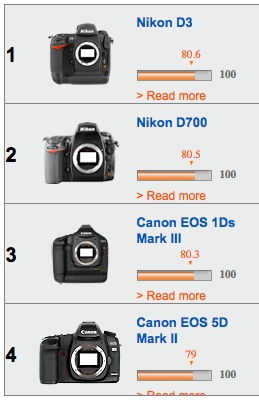
The Top 4 Digital Camera Sensors in Overall Image Quality – DxO Labs
How good is your digital camera sensor? How does it compare to other camera sensors in terms of color depth, dynamic range, and low-light high ISO quality? Is there a reliable source where you can find this information?
The good new is yes, there is a great, reliable source for this kind of information – DxO Labs.
Continue reading
TRIPOD RECOMMENDATIONS – BEST TRIPODS – 2008
Looking for a tripod? This is the place to find information, recommended models, and links to more information.
It is best to buy your tripod legs and tripod head separately. The best brands are interchangeable so you can match the legs you want with the tripod head that you want.
For years I have been recommending Bogen/Manfrotto and Gitzo tripods. . . .
IT’S OFFICIAL: The New CANON 5D Mark II
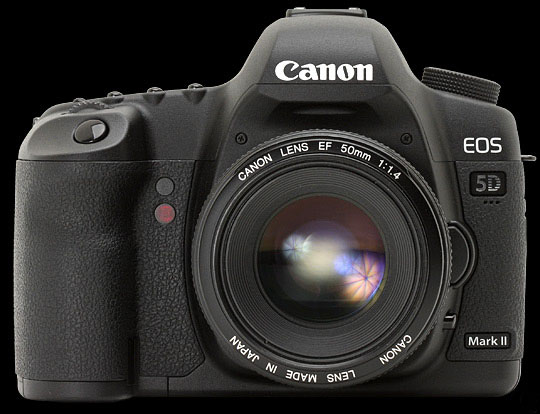
It is now official. After posting teasers on their web sites for the last week, at midnight last night, Canon officially announced the much awaited Canon 5D Mark II.
So what’s new and improved?
*The sensor jumps from 12.8 megapixels on the current model to 21.1 megapixels on the new model. So long as the quality remains good, more megapixels means bigger enlargements.
*High ISO sensitivity jumps from 3200 to 6400 but it can be expanded to ISO 25,600. This is huge news if the quality is still good at the higher ISOs. This should mean better pictures at much lower light levels and faster shutter speeds at lower ambient light levels.
*Now for the really surprising, good news (at least so far as I am concerned). For a long time I have wondered why Canon didn’t put a movie mode in a digital SLR. This is a basic feature of many point and shoot digital cameras and it is one of the reasons I run around with a digital point and shoot (the Canon Powershot S3 IS). I like to capture short video clips. Canon finally did it. The Canon 5D Mark II incorporates full HD (1920×1080) video at 30 fps. Finally!! This is the first and only (as of Sept 17) D-SLR to provide a High Definition movie mode. You can play high resolution movies from the new Canon 5D on your HD TV.
*The 5D Mk II has Auto ISO in all modes except manual. If the shutter speed drops below a certain point due to a drop in light levels, the camera jumps the ISO to maintain the desired shutter speed.
More additions and upgrades to the 5D Mark II:
*The dust reduction feature that is part of several other Canon D-SLRs.
*Digic IV image processing.
*A still photo continuous capture rate of 3.9 frames per second.
*“Live View” mode with many options.
*A 3 inch high resolution (VGA) LCD screen.
There is a lot more to this camera but the feature above interest me the most. You can read an excellent preview at DPReview.com.
The specs sound very good. How good is this camera really? I will let you know when reliable test reports begin to appear.
As always, I recommend that you wait to buy any new model of camera until a few months after the camera hits the shelves. That will give Canon time to work out the “new model bugs†that so often happen. The 5D Mark II should be “bug free” a few months after its release. (I know you can hardly resist if you have been waiting for this model.) The cost is expected to be around $2700 USD.
Canon’s 5D Mark II promo page.
Canon has posted a couple of downloadable, full-sized jpeg images here.
CANON EF vs EF-S LENS CONFUSION
A recent discussion at a popular web site reveals the continuing confusion over the differences between Canon EF and EF-S lenses. Bad advice from camera stores does not help.
REVIEW: CANON EF 70-200mm f/4L IS USM LENS
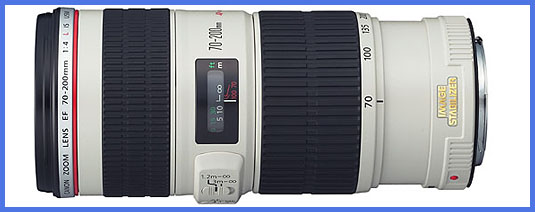
The new Canon EF 70-200 mm f/4L IS lens
The new Canon EF 70-200 mm f/4L IS USM lens is now available. This is a great lens!
2nd LOOK: Canon EF 24-105mm f/4L lens
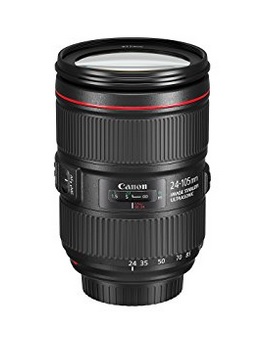
I wrote about this lens when it was announced last August. Enough reviews have been posted to give this lens a second look. The news is very good. Read more at my article here.
You can buy this lens in this section of my Amazon powered photography store.

