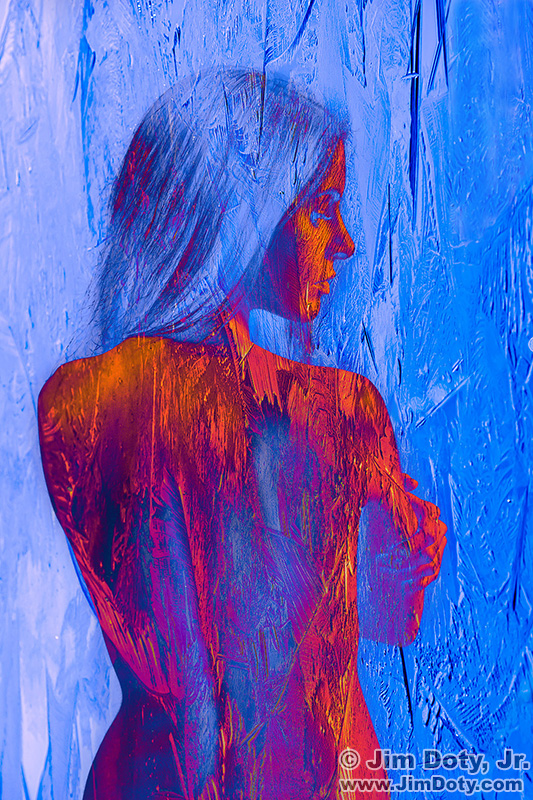
Kristina, “Fire and Ice”
Although you wouldn’t guess it from the image above, 99% of the time I am pretty much a photographic purist. What you see in my images is what you would see if you were standing right next to me when I clicked the shutter.
When I started posting landscape photos on Facebook about 15 years ago, one person in particular would regularly ask me, “Is this real or is this Photoshop?” And my answer would be, “This is real”, or “This is the same thing you would see if you were standing next to me when I clicked the shutter.”
The problem was she was used to seeing boring images of average subjects in average, ordinary light. So images created in stunning natural light looked fake to her.
When I first developed a serious interest in photography, one of my first mentors, via his books and magazine articles, was Galen Rowell. He was a photographic purist. The photos he published were as true as slide film could get to what his eyes were seeing when he clicked the shutter. The dramatic light in his images wasn’t Photoshop, it was because he worked long and hard to be in situations where dramatic light might occur. He chose his slide films, and used neutral density filters, to come as close as he could get to capturing on film what his eyes were seeing. I have several of his books and two of them were autographed by Galen. Galen’s book Mountain Light was one of the three most important books in shaping me as a photographer. I don’t cry when famous people die, but I shed tears when I heard Galen and his wife had died in a tragic plane crash. That was the kind of impact he had on me as a photographer.
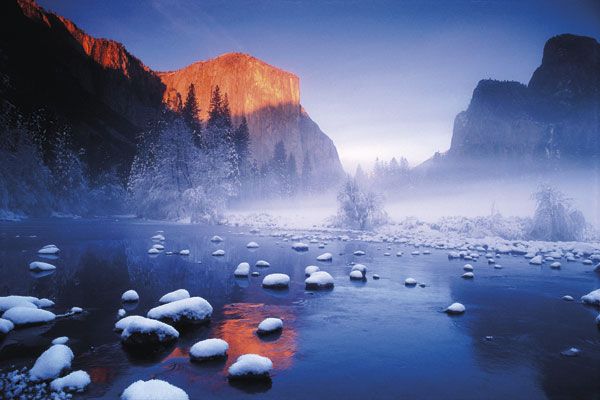
Galen Rowell, Winter Sunset Gates of the Valley, 1990
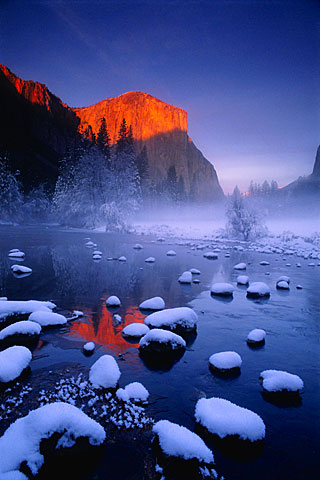
Galen Rowell, Gates of the Valley, Yosemite, 1987
Two of Galen’s classic images. In 2015 I went looking for the same spot.
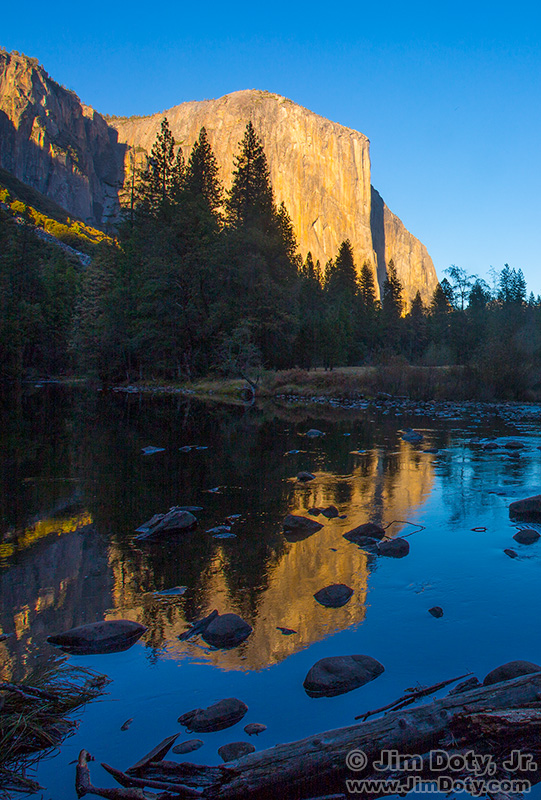
Gates of the Valley, Yosemite National Park, California. October 25, 2015.
I ended up at the same spot where Galen created his images, give or take 10-15 feet. The light was good when I was there. When Galen was there in 1987, the light was glorious.
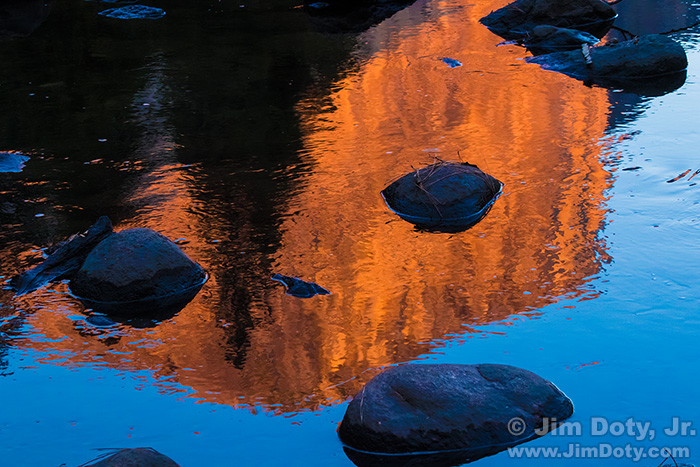
El Capitan Reflection, Gates of the Valley, Yosemite National Park, October 25, 2015.
As the light got more intense I created this reflection image.
Galen finally consented to allowing some of his images to be Photoshopped when a trusted friend pointed out that images out of the camera can fall short of what your eyes are seeing when you click the shutter . So Galen allowed some of his images to be Photoshopped to bring them closer to “visual reality”, what his eyes were seeing when he clicked the shutter.
That is especially true today of digital camera images. Digital images right out of the camera do not have the light to dark dynamic range that your eyes have, and no digital camera can capture the full range of color tones that your eyes can see. In some situations digital camera images fall far short of what your eyes were seeing due to the dramatic light and a dynamic range that the camera simply cannot capture. Photoshop can bring back some of what the camera can’t fully capture. In some situations, “If it isn’t Photoshop, it isn’t real.” In other words, Photoshop is necessary when the image falls short of “visual reality”, what your eyes were actually seeing.
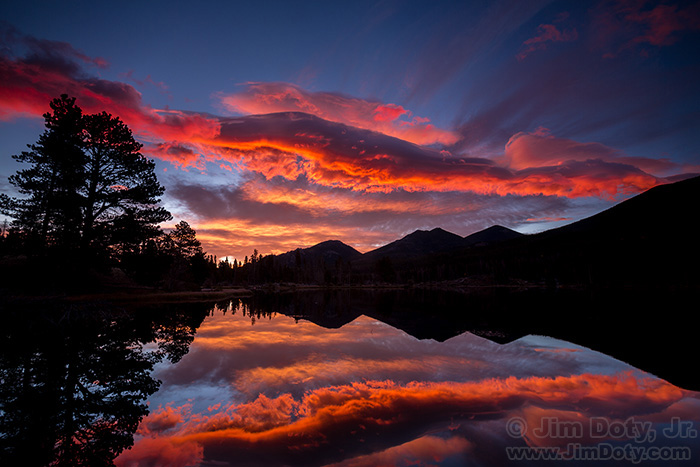
Dawn at Sprague Lake, Rocky Mountain National Park, Colorado.
Bob (my brother-in-law and photo buddy of many years), and I got up super early to be at Spague Lake. This is the glorious light that developed. What you see in this image is what we saw when we were standing there. This is visual reality.
If you are a photographer for NatGeo, a news magazine, or a newspaper, photographic purism is the rule of the day. The photos have to be true to what was happening in real life. A photographer for a news magazine lost his job when he digitally removed an object from one his news photos. Photographers in the news biz are allowed to crop images, and to adjust exposures, color temperature, and the colors in the image to bring them closer to visual reality, but not to digitally add or subtract people and things. (This does not apply to scandal mags you see at the store which will print outlandishly altered or untrue stories and doctored or totally made up photos.)
Having said all of that, every once in a while I want to create something really different from what my eyes were seeing. I go Photoshop crazy. That’s ok too. The image at the top of this article is an example. Let’s look at its evolution.
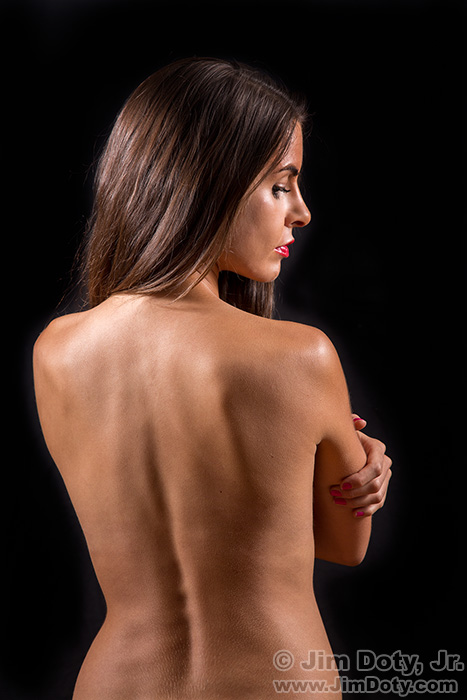 This is the original color image.
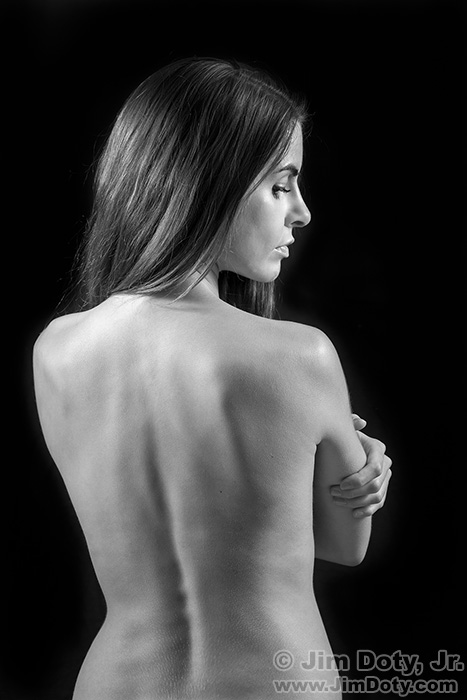
Kristina
First I converted it to black and white. I like this version a lot. This is still considered photographic purism but in black and white. Then I started with a series of variations, combining this image with other images.
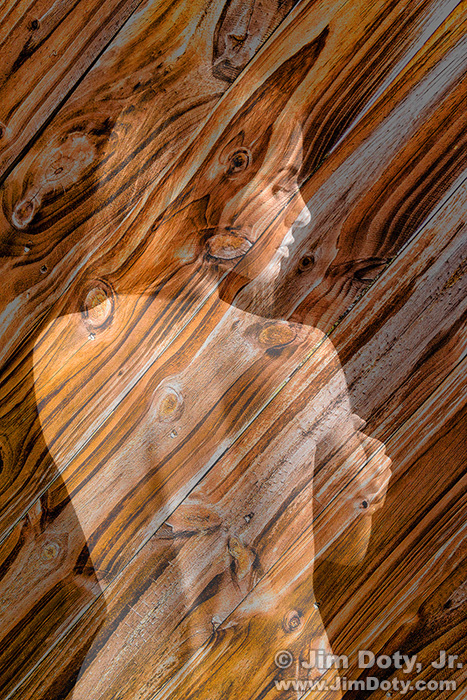 First I combined the image with a photo of a wooden fence. We have now left true to life visual reality
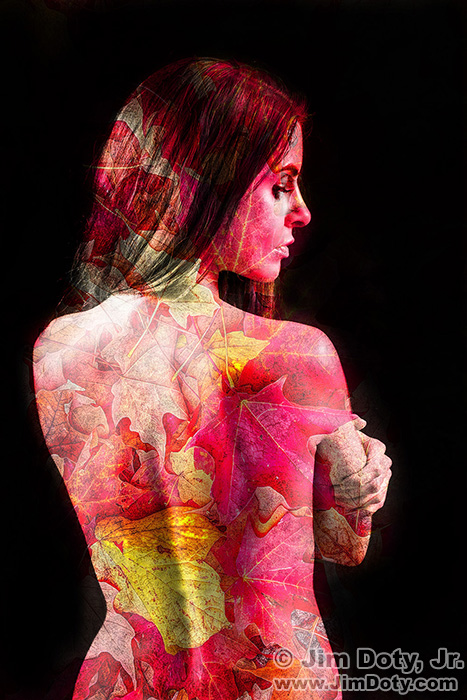 Then I tried autumn leaves.
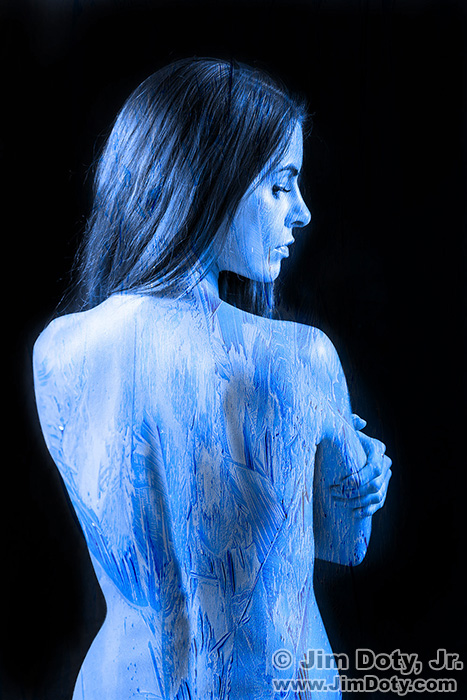 Next I took an image of frozen ice on a lake in Colorado, turned it vertical, and blended it with the image of Kristina.
Kristina, “Fire and Ice”
Then I manipulated the color of the ice and I ended up with this colorized “Fire and Ice” version. I love this version! And it is a far cry from the original.
I do appreciate it when photographers point out the difference between an image that is true to visual reality and a digitally altered or composite image. Of course in this case it is obvious that I changed the image.
When it comes to nature and landscape photography, I prefer visual reality. I do not like added clouds or added animals or dramatic changes to the image. I want to know what it looked like when the photographer was there. Fake lake landscape images do nothing for me. So I follow the nature photographers who work hard to capture mother nature at her best.
As you can guess from the images above, when it comes to portraits it does not matter to me if a person is a photographic purist or not.
The exception is when I do portraits in the landscape. Those are real. Once upon a time I photographed Sarah, a favorite model and friend, out in a wind blown lake. Her reflection was rippled by the water. Someone wrote to me and asked how I digitally put a nude model in the lake and created a rippled reflection with Photoshop. I told him image was real. Sarah really was standing out in Lake Michigan and mother nature did the ripples. The photo is exactly what I was seeing when I clicked the shutter. I do not fake models in the landscape. You can see the photo of Sarah in Lake Michigan here.
I do care about photographic honesty. I was asked to digitally remove a small and irrelevant sign from an image that would appear in a newspaper. I made sure the editor labelled the image as “digitally altered”.
Years ago a photographer posted an image of a polar bear and a penguin in an icy landscape, something that never happens in the real world. He labelled the image as a composite. It is a fun image due to its impossible setting and the way he put it together. There is a place for fun, digitally altered images which are not true to reality.
But there are sites on Facebook that post fake, AI landscape images of things that are impossible in the real world, and they try to pass them off as real. That I do not like. Posting fake images and saying they are real is not ok.
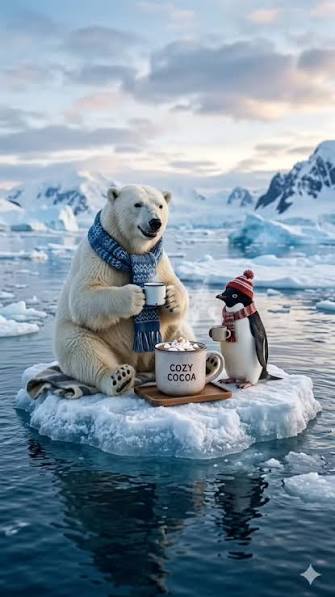 An example of fun AI art floating around the internet. This does not happen in the real world. How can you not love this?!
Links
Channeling My Inner Galen Rowell
How to Photograph “Gates of the Valley”